When Your Auto Shop Is Actually on Your Side: What It Really Means to Put the Customer First
There is a version of automotive service that checks every visible box. The shop looks professional. The advisor speaks with confidence. The estimate arrives quickly and the recommended services sound reasonable. On the surface, everything appears to be working in your favor.
But appearances and reality are two different things entirely.
The gap between a shop that performs customer care and a shop that actually delivers it is one of the most consequential distinctions a vehicle owner can learn to recognize. One version optimizes for the interaction. The other optimizes for the person. One version is built around what generates revenue today. The other is built around what genuinely serves the individual sitting across the counter — today, six months from now, and for every visit that follows.
That second version is the standard that automotive service should have always been held to. It is also, candidly, rarer than it should be. And understanding what it looks like, why it matters, and how to recognize it is worth the time of every driver who depends on their vehicle and wants to know they are being served honestly.
The Trust Deficit the Industry Built for Itself
The automotive repair industry did not arrive at its trust problem by accident. It was constructed incrementally — one unnecessary recommendation at a time, one estimate that expanded without clear explanation, one customer who left the counter feeling confused, pressured, or quietly taken advantage of.
Those individual experiences do not stay contained. They travel. They become the stories people tell when someone in their circle is looking for a mechanic. They become the reason a driver approaches the service counter with their arms metaphorically crossed before the first word is spoken. They become the filter through which every subsequent recommendation — even the legitimate, urgent, genuinely important ones — gets evaluated with suspicion.
The result is a dynamic that serves no one well. The customer is on guard against being oversold, which means they sometimes decline services they genuinely need. The advisor is working against a wall of skepticism that makes honest communication harder. The shop loses the opportunity to build the kind of long-term relationship that would be far more valuable than any single transaction.
That cycle only breaks one way. It breaks when a shop decides — not as a marketing strategy, not as a positioning statement, but as a genuine operational commitment — that the customer's best interest is the non-negotiable foundation of everything it does. Not most of the time. Not when it is easy. Every time.
What It Actually Looks Like to Have the Customer's Best Interest at Heart
This principle is simple to state and demanding to execute. It is not a set of talking points. It is a way of operating that shows up in the specific, observable behaviors of every person in the shop — from the person who answers the phone to the technician who pulls the vehicle into the bay.
It starts with an honest inspection. A shop that is genuinely operating in the customer's best interest performs a thorough, accurate, documented inspection on every vehicle that comes through its doors. The purpose of that inspection is not to generate a list of billable items. The purpose is to give the customer an accurate picture of the actual condition of their vehicle — what is working well, what needs attention now, what is developing and should be monitored, and what can wait. That kind of honest assessment is a service in itself, independent of whether it generates any additional work that day.
It continues with communication that treats the customer as an intelligent adult. Customers are not passive recipients of recommendations. They are people making decisions about a machine they depend on, often with limited technical background but with every right to understand what they are being told and why it matters. A shop that truly has their best interest at heart explains findings in plain language, connects those findings to real-world consequences, and answers questions with patience and clarity — not with jargon designed to end the conversation.
It requires honesty about urgency and priority. Not everything that needs attention requires immediate action. A genuinely customer-first shop communicates the difference clearly and without ulterior motive. It distinguishes between what is a safety concern requiring prompt attention, what is a developing issue that should be addressed within a reasonable timeframe, and what simply needs to be noted and monitored. That kind of honest prioritization builds trust faster than any other behavior in the service interaction.
It demands respect when the customer says no. A customer who declines a recommended service after receiving a clear, honest explanation has made an informed decision. The appropriate response is documentation, respect, and an open door — not guilt, not pressure tactics, not a follow-up designed to make them feel irresponsible for exercising their own judgment. The customer who feels respected when they decline is the customer who comes back. Every time.
It sometimes means saying the vehicle is fine. The most powerful trust-building moment in automotive service is also the one that costs the most in the short term: the moment when the shop looks at a vehicle and honestly communicates that there is nothing additional needed beyond what the customer came in for. That statement costs the shop a potential repair order. It earns something worth far more — the kind of trust that produces a loyal customer who sends everyone they know.
Two Models, Two Outcomes
There are two fundamental ways to run an automotive service business. The first treats the customer interaction as a transaction — a bounded event with a beginning and an end, optimized for the revenue it can generate before the customer walks out the door. The second treats the customer interaction as a chapter in an ongoing relationship — one that will compound in value over months and years in ways that no single transaction ever could.
The transactional model produces numbers that look strong on a short timeline. It can generate impressive repair order averages for a quarter or two. And it reliably erodes the customer base that produces those numbers, because customers who feel sold to eventually stop coming. They do not always announce their departure. They simply do not return. And they tell people why.
The relationship model moves more slowly in the early stages. The shop that tells a customer their vehicle does not need additional work today does not receive credit for that decision on the same afternoon's revenue report. But it does receive something that builds over time into a competitive advantage that cannot be easily replicated: a community of customers who trust the shop, return without hesitation, refer the people they care about, and remain loyal through price changes, inconveniences, and the inevitable occasional mistake — because the foundation of the relationship is genuine.
The shops that build lasting businesses in automotive service are not the ones that optimized every transaction. They are the ones that understood what the relationship was worth and made every decision accordingly.
The Culture Behind the Commitment
A commitment to customer-first service is only as durable as the culture that holds it. Culture is not what is written on the wall. It is what happens in the service bay when the pressure is on and the easier path leads away from integrity. It is the sum of thousands of small decisions made by every person in the building, every day, in moments no one is formally tracking.
Building and sustaining that culture requires intentionality at every level.
Technicians who understand their role beyond the mechanical. The technician's findings are the foundation of every customer conversation. A shop built on genuine customer care ensures that its technicians are trained to find what is actually there — not what it would be convenient to find, not what would pad the repair order, but what is actually present in the vehicle. That requires not just technical skill but professional integrity, and it requires a shop environment that recognizes and rewards that integrity.
Advisors who are educators first. The service advisor's role at a genuinely customer-first shop is to help the customer understand their vehicle and make the best possible decision for their situation. That is different from the role of closing the sale. It requires a different skill set, a different posture, and a different definition of success. The advisor who measures their day by how well they informed and served their customers is operating from a fundamentally different orientation than the one who measures it purely by the size of the repair orders they generated.
Leadership that lives the standard it sets. The culture of a shop reflects the behavior of the people who lead it. When ownership and management make decisions that sacrifice short-term revenue in the interest of maintaining a customer's trust, every person in the building receives a clear signal about what the organization actually values. That signal shapes behavior across the entire team in ways that policy documents and training manuals alone cannot.
A shared understanding that trust is the asset. The shops that sustain genuine customer-first cultures are the ones where the entire team — at every level and in every role — understands that the customer's trust is more valuable than any individual interaction. It is the foundation on which everything else is built. When that understanding is genuinely shared, it becomes self-reinforcing. People hold each other to the standard not because they are required to, but because they understand what is at stake.
Kernersville, NC and the Roads That Connect This Community
The drivers of Kernersville and the surrounding Piedmont Triad region navigate a specific set of conditions that make honest, thorough automotive service genuinely important to their safety and the reliability of their vehicles.
NC Highway 66, which runs directly through Kernersville and connects the community to Kernersville's surrounding municipalities, carries steady daily traffic from residents commuting to and from Winston-Salem to the west and Greensboro to the east. That corridor — along with US-421, Business 40, and I-40 — sees the kind of consistent highway mileage that accumulates wear on brake systems, tires, drivetrain components, and suspension in patterns that are easy to miss without a thorough, honest inspection.
The Piedmont Triad's seasonal variation adds its own demands. The mild but genuine winters in Kernersville and across Forsyth County bring occasional ice events on surface roads and bridges throughout the area. The hot, humid summers place real demands on cooling systems, belts, and fluid integrity. Drivers in Kernersville, Oak Ridge, Summerfield, Colfax, and across the broader Greensboro and Winston-Salem metro area depend on vehicles that can handle that range of conditions reliably.
The residential neighborhoods and business corridors that make up Kernersville — from the routes along Downtown Kernersville to the surface streets connecting to neighboring Guilford County — represent a community where people depend heavily on personal transportation for work, family, and daily life. That dependence makes the honesty and competence of the shop they trust with their vehicles not just a matter of convenience, but a matter of genuine consequence.
What Happens When a Community Finds a Shop It Can Trust
Trust in an automotive shop does not stay private. It moves through a community the same way distrust does — through conversations, through social networks, through the organic recommendation that happens when someone in a neighborhood group or a workplace asks where to take their car.
The difference is in the direction. Distrust spreads as a warning. Trust spreads as a gift — freely given, genuinely felt, and more persuasive than any advertisement a shop could run. When a driver in Kernersville has an experience where they felt genuinely informed, genuinely respected, and genuinely served by a shop that appeared to be working entirely in their interest, they tell people. They become ambassadors not because they were asked to, but because the experience was meaningful enough to share.
That kind of reputation takes time to build. It requires consistent behavior across hundreds of interactions, through the interactions that are easy and the ones that are not. It cannot be manufactured. It cannot be accelerated by promotional offers or loyalty programs alone. It grows the way trust always grows — through repeated demonstrations of genuine integrity, over time, in a community that is paying attention.
The shops that invest in building that reputation are the ones that become institutions in their communities. They become the shop that people mention without being asked, the shop that earns multi-generational customer relationships, the shop that survives the economic cycles and competitive pressures that diminish businesses built on thinner foundations.
The Standard That Should Need No Explanation — But Does
It says something meaningful about the automotive service industry that positioning a shop as genuinely honest represents a competitive differentiator. Honesty should be the baseline. It should be the floor of acceptable behavior, not a feature worth advertising.
But the reality of the customer's experience — shaped by years of encounters that taught skepticism as a survival skill — means that genuine integrity stands out. It stands out because it is recognizable. It stands out because it feels different from what the customer has been conditioned to expect. And when a customer encounters it, they notice.
They notice when the advisor explains something clearly without talking down to them. They notice when the estimate comes back and nothing was added that they did not discuss. They notice when the shop calls to tell them the vehicle is ready and the bill matches what was quoted. They notice when a concern they raised was actually listened to, investigated, and reported on honestly. And they notice — perhaps most powerfully of all — when the shop tells them their vehicle does not need anything additional and sends them on their way without pressure.
Each of those moments is a deposit in a trust account that compounds over time. And the shop that makes those deposits consistently, across every customer and every interaction, is building something that its competitors cannot easily replicate.
Genuine Car Care Center: Where the Name Reflects the Standard
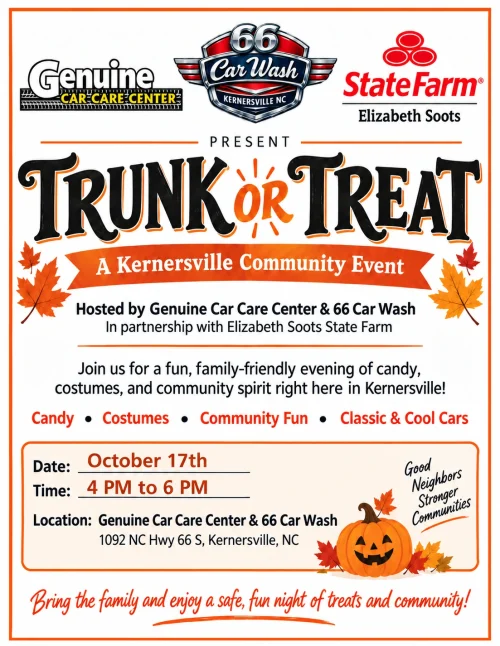
Located at 1092 NC Highway 66 S in Kernersville, North Carolina, Genuine Car Care Center serves drivers throughout Kernersville and the surrounding Piedmont Triad communities — including those commuting along NC-66, US-421, Business 40, and I-40, traveling through Winston-Salem, Greensboro, Oak Ridge, Summerfield, Colfax, and across Forsyth and Guilford Counties — with a commitment to automotive service that is built entirely around the customer's genuine best interest.
The name is not incidental. Genuine Car Care Center was built on the understanding that the word genuine means something — that it carries a standard of honesty, thoroughness, and integrity that must show up in every inspection, every conversation, every recommendation, and every interaction with every customer who walks through the door.
That means a team of technicians who find what is actually there and report it accurately. Advisors who communicate clearly, educate honestly, and respect the customer's decisions without pressure or manipulation. A shop environment where the customer's trust is understood to be the most valuable asset in the building — more valuable than any single repair order, any weekly target, or any short-term metric.
Genuine Car Care Center brings that standard to every service it provides — from routine maintenance and tire care to complex diagnostics and full mechanical repair — serving the drivers of Kernersville and the broader Piedmont Triad with the consistency and integrity that the word genuine demands.
If you are ready to work with a shop that is genuinely, completely, non-negotiably on your side, contact Genuine Car Care Center at (336) 993-8473 or visit genuinecarcare.com to schedule your appointment.
The Closing Truth About What Automotive Service Should Be
There is only one version of automotive service worth building — the version that places the customer's best interest at the center of every decision, every day, without exception. Not because it is the easiest path. Not because it maximizes short-term revenue. But because it is the only version that produces something durable: a business built on trust, sustained by integrity, and grown by the community it genuinely serves.
The shops that understand this are the shops that last. They are the shops that grow not through promotional offers or aggressive advertising alone, but through the far more powerful engine of customers who trust them completely and tell everyone they know.
That is the standard. It always has been. And it is the only one worth holding.
You can watch the video